Does meditation help with anxiety?
Yes, on average. Structured mindfulness programs can reduce anxiety symptoms, though the average benefit is usually modest. Mindfulness can also help people feel less stressed. The size of the benefit depends on what people practice, who takes part, and what the researchers compare it with. [1, 2]
When researchers talk about meditation for anxiety, they often mean mindfulness meditation. A typical exercise is to pay attention to the breath, notice when the mind drifts into worry or planning, and gently bring attention back.
How much can it help with anxiety?
A systematic review published in JAMA Internal Medicine pooled randomized trials that compared meditation programs with groups given something else to do. On average, mindfulness programs produced a modest improvement in anxiety symptoms at eight weeks. The average difference was smaller at follow-up three to six months later. Both results describe how groups scored on anxiety scales. An individual can feel a meaningful improvement, a small shift, or very little change. [1]
What the comparison group does matters. Comparing a course with a waiting list tells you what happens when people are offered the whole course, including time with an instructor and other participants. Comparing it with a credible alternative gives a better sense of whether mindfulness adds anything beyond those shared features. In a broad review of programs for adults outside clinical settings, benefits for anxiety and psychological distress were clearer against no intervention, and comparisons with other activities were less conclusive. [3]
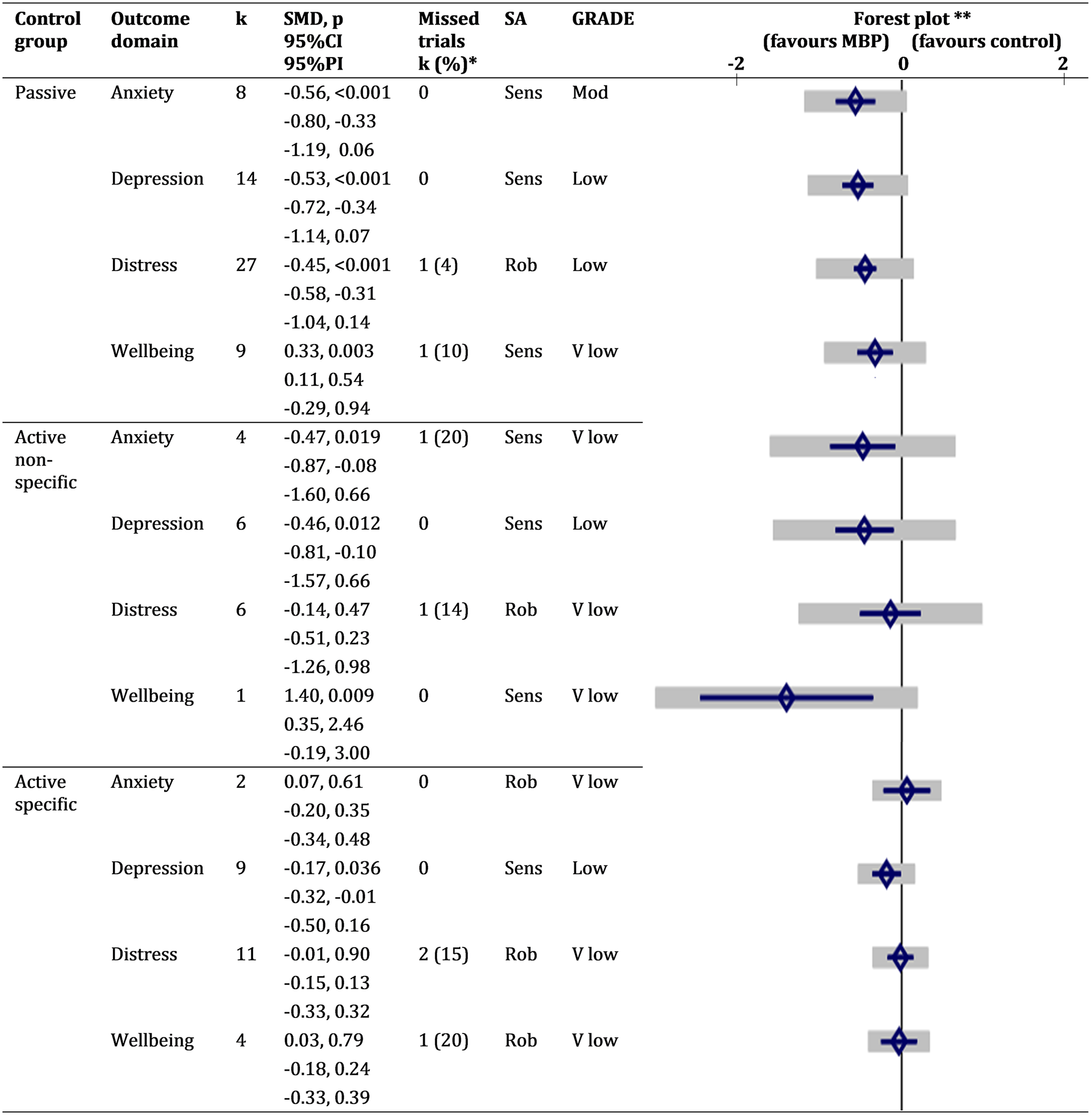
Anxiety one to six months after a mindfulness program. Start with the first row, under “Passive.” Across eight trials, the average anxiety score was 0.56 standard deviations lower with mindfulness than with no intervention or a similar passive control (95% confidence interval, 0.33 to 0.80 lower). The wider grey bar shows how much the result could vary in a new trial. The rows for active comparisons draw on fewer trials, and the authors rated that evidence as very low certainty.
Galante et al., PLOS Medicine (2021), Figure 2. Reproduced as published under CC BY 4.0. Click the figure to enlarge.
What about everyday stress?
A 2026 review of 17 randomized trials found that adults outside clinical settings reported feeling less stressed after a mindfulness program than people in the comparison groups. The size of the difference varied considerably across studies. The researchers used questionnaires to measure perceived stress, or how stressful people found their lives. A lower score reflects a change in how someone experiences the demands they face. [2]
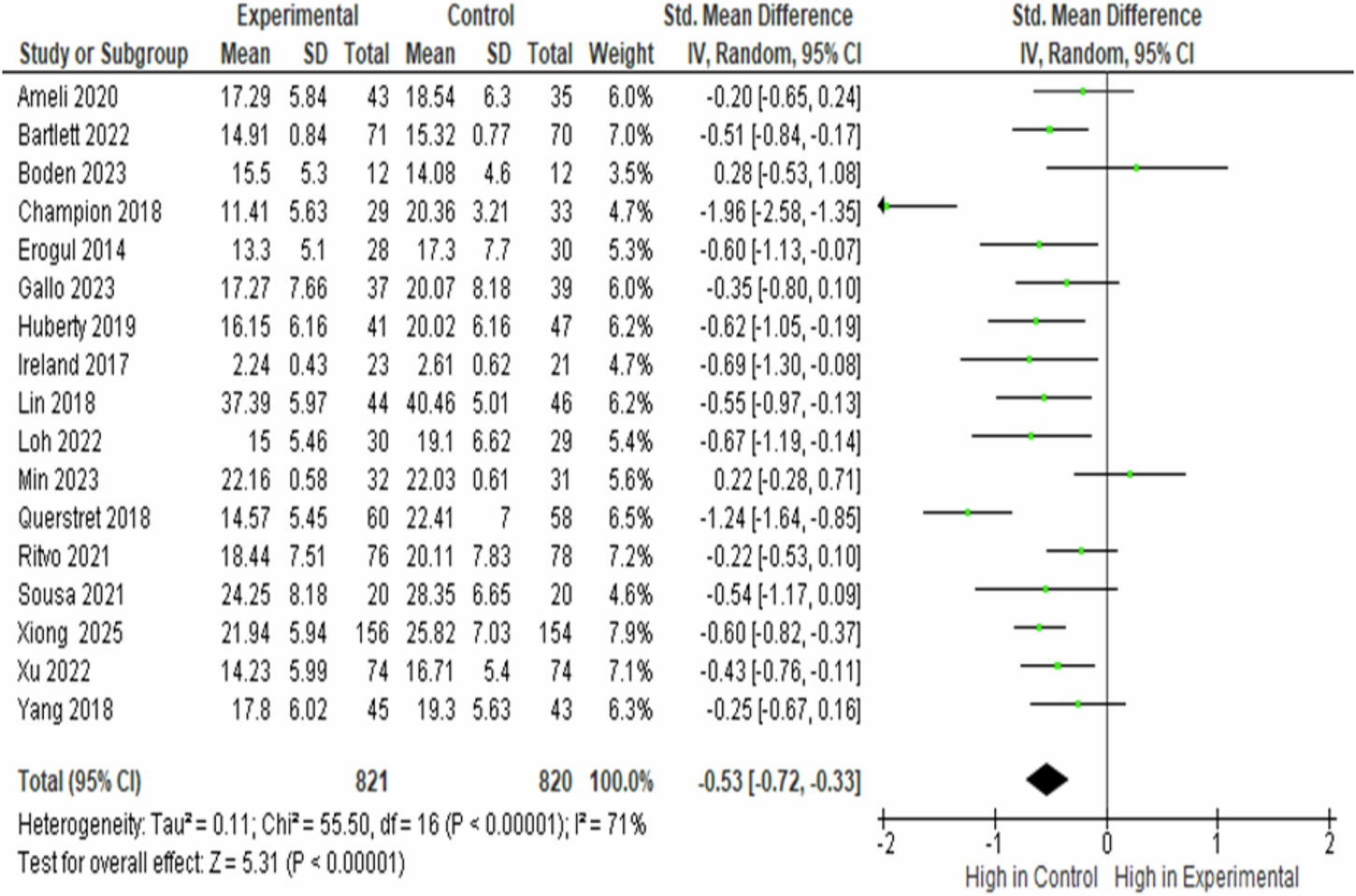
Perceived stress after mindfulness training. Each row represents one study. The diamond at the bottom combines all 17 studies. The mindfulness groups averaged 0.53 standard deviations lower on perceived stress than the comparison groups (95% confidence interval, 0.33 to 0.72 lower). The vertical line marks zero difference. Several individual study intervals cross it.
Rajan et al., npj Mental Health Research (2026), Figure 5. Reproduced as published under CC BY 4.0. Click the figure to enlarge.
A separate analysis used individual data from 2,371 adults across 13 trials. People offered a mindfulness program reported modestly lower psychological distress one to six months afterwards than people in passive comparison groups, such as a waiting list. Psychological distress is a broader measure that can include symptoms of anxiety and depression. [4]
What if you have an anxiety disorder?
A randomized trial published in JAMA Psychiatry assigned 276 adults with diagnosed anxiety disorders to either escitalopram, a medication used to treat anxiety, or an eight-week course called Mindfulness-Based Stress Reduction (MBSR). The course included weekly 2½-hour classes with a qualified instructor, a day-long retreat and 45 minutes of assigned practice at home each day. [5]
After eight weeks, clinician-rated severity fell by about 1.4 points on a seven-point scale in each group. The study met its prespecified noninferiority criterion. On that scale, the results ruled out MBSR trailing escitalopram by 0.4 points or more, the threshold the researchers had set in advance. In a later phase of the same research project, the comparison between the two treatments delivered by video call did not meet that criterion. The evidence is clearest for the specific in-person course studied. [5, 6]
Can a meditation app help?
A 2024 review of randomized trials found a small average improvement in anxiety symptoms for mindfulness apps compared with control groups. There were too few comparisons with active treatments, such as other therapeutic programs, to draw a firm conclusion about how apps stack up against them. Even within the app studies, the programs varied. A few minutes of practice can be a manageable way to start. The review estimated an average benefit across the apps it studied. How much relief to expect from a brief session or from Ona specifically remains unknown. [5, 7]
When to get support
Some people report feeling more anxious during or after meditation. If practice consistently makes you feel worse, it’s reasonable to pause. If anxiety is persistent or is interfering with sleep, work or relationships, talk with a health professional. Cognitive behavioural therapy (CBT) and medication are established options for generalized anxiety disorder. If you already take medication, talk with your prescriber before changing it. [8, 9, 10]
References
- Goyal M et al. Meditation programs for psychological stress and well-being. Systematic review and meta-analysis. JAMA Internal Medicine (2014). Read the study
- Rajan A et al. Mindfulness-based interventions for perceived stress in nonclinical adults. Systematic review and meta-analysis. npj Mental Health Research (2026). Read the study
- Galante J et al. Mindfulness-based programs in nonclinical settings. Systematic review and meta-analysis. PLOS Medicine (2021). Read the study
- Galante J et al. Mindfulness-based programs for mental health promotion. Individual participant data meta-analysis. Nature Mental Health (2023). Read the study
- Hoge EA et al. In-person mindfulness-based stress reduction versus escitalopram for anxiety disorders. Randomized trial. JAMA Psychiatry (2023). Read the study
- Hoge EA et al. In-person and remotely delivered mindfulness versus escitalopram for anxiety. Journal of Affective Disorders (2025). Read the study
- Linardon J et al. Mindfulness apps for symptoms of depression and anxiety. Updated meta-analysis of randomized trials. Clinical Psychology Review (2024). Read the study
- Farias M et al. Adverse events in meditation. Systematic review. Acta Psychiatrica Scandinavica (2020). Read the study
- NHS. Get help with anxiety, fear or panic
- NICE. Generalised anxiety disorder and panic disorder in adults. Clinical guideline CG113